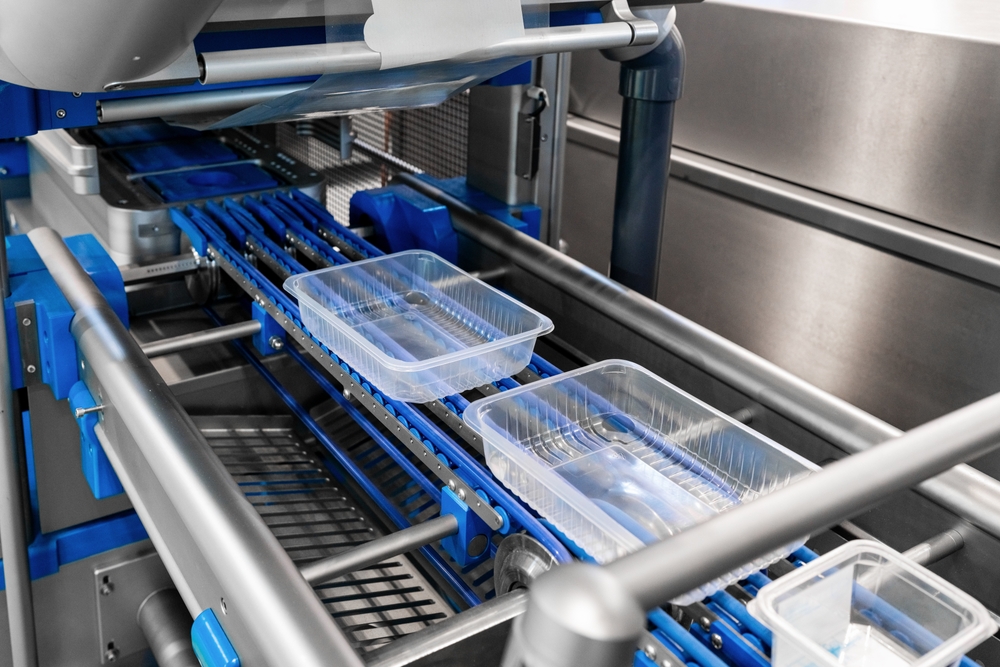
Most processors who move from CPET to fiber-based or mono-material trays discover the same thing within the first production trial: the tray changed, the seal window did not follow. A packaging sealing machine that has run crystallized PET for years will usually need new tooling tolerances, revised temperature and dwell settings, and a different approach to tray handling before fiber trays seal reliably. The adjustments are manageable, but they are rarely plug-and-play.
The pressure to switch is real. Recyclability claims, retailer packaging scorecards, and recycled-content targets have pushed molded fiber, coated paperboard, and mono-material PP or PET trays onto production lines that were specified around CPET. Planning the operational changes in advance is what separates a two-week transition from a six-month one.
Why CPET Settings Do Not Carry Over
CPET is thermally stable, dimensionally consistent, and thermoformed to tight tolerances, which is exactly why it became the default for ovenable and retail-ready meals. Flange flatness on a typical thermoformed CPET tray holds within roughly 0.2 to 0.4 mm, so a rigid seal plate can apply even pressure across the entire perimeter without much compensation.
Fiber trays behave differently. Molded fiber has a rougher sealing surface, higher compressibility, and flange variation that commonly runs 0.5 to 1.0 mm or more depending on the forming process. Coated paperboard sits somewhere in between, with its own limits on heat exposure because the barrier layer, not the substrate, forms the seal.
- Surface porosity: fiber wicks and scatters heat rather than conducting it evenly.
- Compressibility: the flange deforms under pressure instead of resisting it.
- Moisture content: paper fiber equilibrates with ambient humidity, which affects both dimension and seal quality.
- Coating chemistry: dispersion coatings, PE, and PET liners each have distinct activation temperatures.
Temperature, Dwell Time, and Pressure Need Re-Mapping
A CPET tray with a PET-based lidding film typically seals somewhere in the 180 to 200 degree Celsius range with a dwell of 0.6 to 1.2 seconds. Fiber trays with water-based dispersion coatings often require lower plate temperatures, roughly 140 to 170 degrees Celsius, because higher settings scorch the coating or delaminate it from the substrate.
Dwell time usually moves in the opposite direction. Because fiber conducts heat poorly and the flange surface is uneven, many operations land between 1.2 and 2.5 seconds to get a consistent hermetic seal. Sealing pressure often needs to increase as well, though there is a ceiling: too much force crushes the flange and creates channels rather than closing them.
Treat the three variables as a single map, not three independent dials. The practical method is a designed trial that steps temperature in 5 degree increments at two or three dwell settings, with seal strength and leak results recorded at every point.
Tooling Changes on the Sealing Head
Rigid aluminum seal plates sized for CPET rarely deliver acceptable results on fiber. Most conversions call for tooling modifications that let the seal surface accommodate flange variation rather than fight it.
- Wider seal bands: moving from a 2 to 3 mm band to a 4 to 6 mm band adds tolerance for flange irregularity.
- Compliant counter-pressure: silicone or spring-loaded backing pads distribute force across an uneven flange.
- Tray nest depth: fiber trays sit differently in the nest, and existing pockets often need machining or replacement.
- Cut-and-seal versus seal-only: fiber dust behaves badly around cutting knives, so some lines move to pre-cut lidding.
Tooling lead times are the hidden schedule risk. New or modified tray tooling commonly runs six to twelve weeks from most packaging machine suppliers, which is why tray selection should be locked before tooling is ordered rather than after.
Denesting, Handling, and Fiber Debris
Fiber trays nest more tightly than thermoformed CPET and separate less predictably, particularly at the bottom of a stack. Vacuum cup denesters that worked on smooth PET may need larger pads, higher vacuum, or mechanical finger denesters instead.
Loose fiber is the second handling issue. Dust accumulates on seal plates, sensors, and the film path, and any fiber that lands in the seal area becomes a leak path. Operations running molded fiber typically add a cleaning step to every shift changeover and inspect seal tooling daily rather than weekly.
Storage and Conditioning Before the Line
Paper-based trays equilibrate with the warehouse environment, so a pallet stored in a humid dock area will not perform the same as one stored in a conditioned room. Most fiber tray specifications call for storage between 45 and 60 percent relative humidity, with 24 to 48 hours of conditioning at line ambient conditions before use.
Skipping conditioning shows up as intermittent seal failures that appear random. Before changing machine settings in response to a failure pattern, verify the tray storage record for that lot.
MAP Performance and Seal Verification
Modified atmosphere packaging remains achievable on fiber trays with a proper barrier liner, but the margin for error narrows. Residual oxygen targets that were routinely held under 1 percent on CPET may drift to 1.5 or 2 percent if the seal window has not been re-established, and leak rates tend to be more sensitive to flange contamination.
Build the verification protocol around recognized methods instead of visual inspection alone. Seal strength testing under ASTM F88 gives a quantified peel value, and bubble emission or vacuum decay leak testing catches channel defects that a pull test will not.
- Run a minimum of 30 packages per setting combination, not three.
- Record peel force, seal appearance, and leak result for each.
- Hold a subset through the full distribution and shelf-life period.
- Re-test after a full production shift, once tooling has reached thermal steady state.
Expected Impact on Line Throughput
Longer dwell time has an arithmetic consequence. A line cycling at 12 strokes per minute on CPET with a 0.8 second dwell may settle at 9 to 10 strokes per minute once dwell extends to 1.8 seconds, a throughput reduction of 15 to 25 percent on the same equipment.
There are ways to recover that capacity: adding cavities per cycle, moving to a larger sealing station, or shifting to a tray format that seals faster. Those options carry capital cost, so the throughput analysis belongs in the business case at the start, alongside the tray unit price comparison.
Material availability also deserves attention. The EPA reports that containers and packaging account for roughly 28 percent of municipal solid waste generation in the United States, which is a large part of why recyclable tray demand keeps rising and why supply of specific fiber formats can tighten. Current figures are published in the agency’s containers and packaging data.
A Practical Sequence for the Transition
- Select two or three candidate trays and obtain full technical data sheets, including coating type and recommended seal conditions.
- Request lidding film recommendations from the film supplier for each tray, in writing.
- Run bench or pilot trials on a test sealing head before committing to production tooling.
- Order tooling only after a tray and film combination has passed seal strength and leak testing.
- Validate on the production line across a full shift, including startup and changeover conditions.
- Update SOPs, operator training, and cleaning schedules to reflect the new material.
Frequently Asked Questions
Can an Existing Tray Sealer Run Fiber Trays Without Modification?
In roughly half of cases the base machine is suitable, but tray tooling almost always needs modification or replacement. The sealing station, controls, and gas flush system usually carry over, while nests, seal plates, and denesting components are the components most often changed.
How Much Slower Will the Line Run on Fiber Trays?
Expect a 15 to 25 percent throughput reduction on the same equipment when dwell time roughly doubles. Adding cavities per cycle or upgrading the sealing station can recover most of that capacity.
Are Fiber Trays Suitable for Modified Atmosphere Packaging?
Yes, provided the tray carries a barrier liner rated for the target shelf life, with residual oxygen commonly held between 0.5 and 2 percent. Barrier performance varies widely by coating, so require oxygen transmission rate data from the tray supplier before validation.
What Is the Typical Timeline for a Full Tray Conversion?
Most conversions take 12 to 20 weeks from tray selection to validated production, with tooling lead time of six to twelve weeks as the longest single item. Trials and shelf-life validation account for much of the remainder.
Do Fiber Trays Require Different Lidding Film?
Almost always. A film formulated to seal against CPET will not reliably bond to a dispersion-coated fiber flange, and recyclable tray programs typically call for a matched mono-material or paper-compatible lidding structure.
Plan Your Fiber Tray Conversion With Roberts Technology Group
RTG Packaging works with food manufacturers on tray sealing equipment, tooling, and trial work for ILPRA systems, including conversions from CPET to fiber-based and recyclable formats. Contact our team your tray samples, target output, and film specifications, and the team can outline the tooling and settings your line will need.